Social media marketing can be very successful, although you will achieve a significantly better conversion rate with email marketing. Basically, any marketing expert will confirm this.
Please don't get me wrong. When used correctly, social media can do more than just generate traffic. It allows you to address your target group in a targeted manner. But ultimately, you need a channel that will help you retain your target group in the long term.
This is exactly what email marketing is good for. Even today, emails still convert better than any social media post could ever hope to. And that's what this guest post is all about.
{{divider}}
Reach many people with social media
As I explained at the beginning, social media marketing is an excellent way to draw people's attention to a product or similar item. This is particularly true because hardly any other website connects so many active people.
Facebook alone has 1.82 billion active users per month. (Source: Statistia 2020) However, this does not necessarily mean that you have to be active on all networks at all costs. On the contrary less is sometimes more in social media marketing.
However, you should deliver high quality content that inspires readers on the networks where you want to publish social media posts. If you want to be noticed among so many posts, you have to stand out.
This doesn't just mean creating great content. You need to write text that invites people to read and click. The featured image should be appealing and have a specific size. Just as you shouldn't ignore the time of day and your target audience.
Just take a look at the following graphic from Blog2Social. It provides you with 7 tips for better social media posts that attract attention. This will help you achieve a high conversion rate.
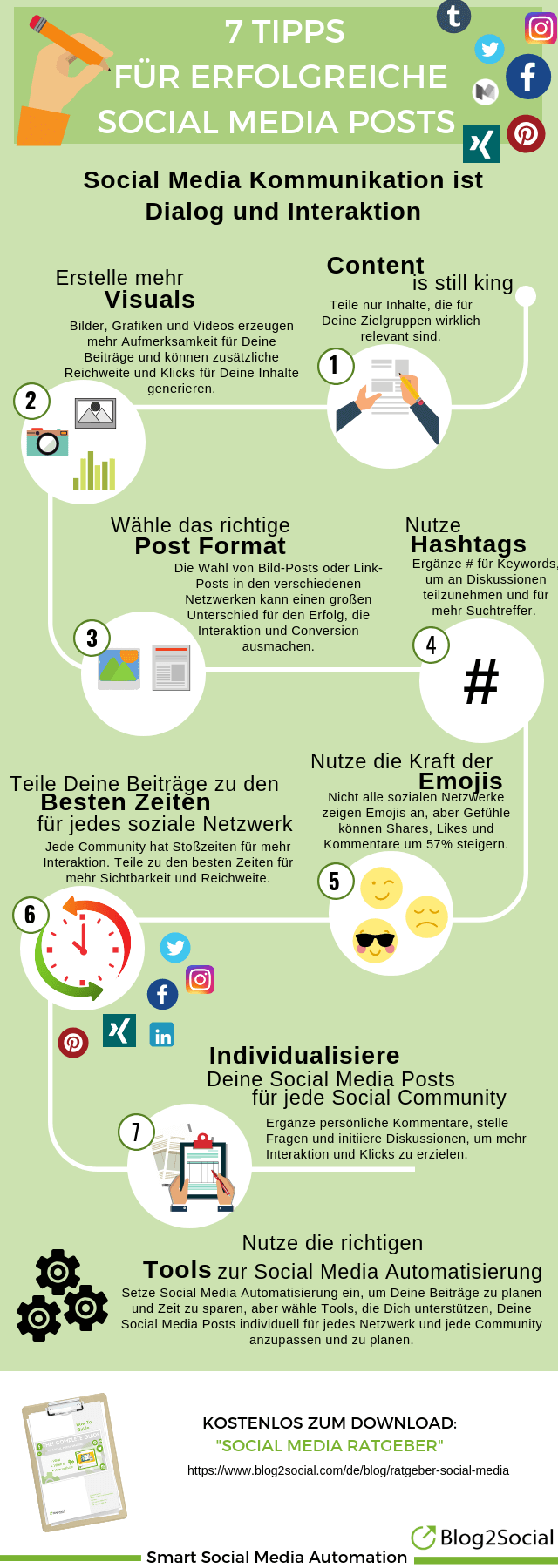
You should pay particular attention to the quality of your posts, the right image formats, the timing, and emojis. Studies show that content is king, even on social media. Supported by impressive graphics and emojis, which make you appear more authentic/human, you will generate more attention.
If you then publish at times when your target audience is active, you will reach the largest possible audience. By the way, you should test the perfect time. Although there are plenty of analyses on this topic, they cannot be applied to every website.
Your task is to find out whether your target group might prefer other times. For example, soccer fans are often active on Saturdays between 1 p.m. and 6 p.m., unlike other target groups. This is because most games in the German Bundesliga take place at these times. Business contacts, on the other hand, have Saturdays off.
{{divider}}
Why look at the conversion rate in content marketing?
Content marketing, or marketing in general, usually aims to increase sales. Whether on a private blog created with WordPress or on a company website.
Most existing websites want to make money on the internet. So if you manage to generate as much revenue as possible with as few hits as possible, you're basically doing a lot right!
{{divider}}
What is conversion?
In this process, the so-called conversion rate plays an extremely important role in this process. The higher it is, the more likely people are to become potential customers. This, in turn, can (but does not necessarily) lead to more sales. Wikipedia describes the term conversion in a similar way Wikipedia describes the term conversion.
Conversion refers in marketing, especially online marketing, to the transformation of a target person's status into a new status, e.g., the transformation of a prospect into a customer.
Source: Wikipedia
{{divider}}
What are the typical conversion rates?
To determine average conversion rates, we should first demonstrate how the rate is calculated. You can easily calculate this using a formula. Multiply the "successes" (e.g., purchases) by 100 and then divide the value by the number of visitors.
Why not just share the successes with visitors? Because you have to take bots etc. into account. Visitor numbers are usually quite inaccurate. This formula has therefore become established in online marketing.
Here's a quick example. You sell an e-book on a landing page. It has been purchased 30 times in a month. You have attracted a total of 10,000 visitors. Your conversion rate would then be 30 x 100 / 10,000 = 0.3%.
In this example, as you can probably see for yourself, you urgently need to make optimizations. Take a closer look at the accompanying graphics. There you can see the current click and conversion rates in various industries for Facebook advertising.


While click-through rates vary between 0.47 and 1.61 percent, conversion rates of 2.31 to 14.29 percent are normal. The average is 9.21 percent for conversions and 0.90 percent for click-through rates.
What does that tell you? Let's assume again that you have 10,000 visitors per month. With average values of 0.90 / 9.21, you would achieve 90 clicks and 8 "successes" (purchases / registrations, etc.). This means that 0.08% of people buy a product on your website.
You should aim to achieve a conversion rate of at least 5%. More is always better, of course. Less means that the costs are too high for the benefits achieved. You also need the highest possible click rates. This is the only way to achieve a long-term profit that is acceptable in relation to the costs.
{{divider}}
Email marketing is so much more suitable
According to HubSpot , email marketing is the second most effective tool for building brand awareness in 2019. It also achieves the highest ROI (return on investment) for small businesses. The money invested in advertising is therefore used to generate sales.
According to Social Media Examiner , social media generated 64% more leads in 2018. However, 73% of consumers prefer email contact with companies. Among working people, the figure is as high as 84%.
Due to digitalization in particular, it is now almost impossible for us to do without an email account. Even the older generation is no exception. That's why email marketing is a great way to reach potential customers.
Compared to traditional advertising, click-through rates in emails are significantly higher. This is not only due to banner blindness on websites and ad blockers, but also because someone who subscribes to a newsletter trusts the author. Trust is similar to affiliate marketing, one of the most important factors in selling products.
{{divider}}
Emails convert well, but require a lot of effort.
However, the slight disadvantage of email marketing is the hard work involved. You have to build a mailing list. This needs to be promoted via your website, social media, or advertising.
Added to this is the effort involved in approaching readers at regular intervals. The content needs to be high quality and must build a relationship with the reader. Nevertheless, the reader must be encouraged to click in order to benefit from it. At the same time, you mustn't come across as too annoying. Otherwise, the reader will unsubscribe.
Especially since you also have to comply with many legal requirements. Visitors must give their consent for you to send them emails. This is stipulated in the new General Data Protection Regulation. You need separate consent for advertising. Anyone who does not comply with these rules is liable to legal action. This can quickly become very expensive.
On the other hand, hardly any other advertising medium comes close to such high values. According to Mailchimp , the average open rate is 20% and the click-through rate is 2%. However, with personalized emails, you can increase these figures to 10%, as well as the conversion rate.
{{divider}}
How to significantly improve your email conversion rate?
Analyze performance
No matter what you want to achieve with a website, it is generally important to measure your own performance in order to respond accordingly. This applies to marketing, search engine optimization, and, of course, email marketing.
It is therefore advisable to review the newsletter accordingly. This is the only way to see how often your emails are opened or links clicked. The conversion rate also plays an important role. Most applications in this area offer statistics on mailings anyway.
In my opinion, this should be supported by targeted landing pages, which can then also be analyzed.
Personalized emails convert better
Shortly before, I presented you with some statistics for email marketing. Personalized emails had significantly higher conversion rates. Nowadays, newsletters offer you many options for tailoring messages to the masses.
I use a comprehensive WordPress plugin for this. It allows me to request the first and last names of recipients. These can then be used in the salutation and subject line. I make extensive use of this feature and generally achieve significantly higher open and click-through rates. My open rate averages 35% and my click-through rate is over 10%.
Clear call to action
However, the call to action must be clear. Its placement should also be well thought out. Many experts recommend placing it "above the fold" in emails, i.e., in the area visible to the reader.
Placement above the fold has the positive effect that the reader sees the call to action immediately upon opening the email. This greatly increases the likelihood of a click. It should also offer added value.
Check the shipping times
As with social media marketing, sending times are very important in email marketing. This is because potential customers are not active at all times of the day. But it is precisely during these active times that you should address them. This will help you increase your open rates.
With optimal shipping times, Mailjet has looked into optimal shipping times. According to their findings, the following times are very good. Mailjet has distinguished between B2B (business to business) and B2C (business to consumer).
<span id="test" class="kool-class" " fs-test-element="test"><table class="customTable">
<thead>
<tr>
<th>Weekday</th>
<th>B2B Marketing</th>
<th>B2C Marketing</th>
</tr>
</thead>
<tbody>
<tr>
<td>Monday</td><td>14 – 17 PM</td><td>7 – 9 AM 17 – 22 PM</td></tr>
<tr>
<td>Tuesday</td><td>10 AM – 12 PM 14 – 17 PMUhr</td><td>7 – 9 PM 17 – 22 PM</td></tr>
<tr>
<td>Wednesday</td><td>10 AM – 12 PM 14 – 17 PM</td><td>7 – 9 PM 17 – 22 PM</td></tr>
<tr>
<td>Thursday</td><td>10 AM – 12 PM 14 – 17 PM</td><td>7 – 9 PM 17 – 22 PM</td></tr>
<tr>
<td>Friday</td><td>10 AM – 12 PM</td><td>7 – 9 PM 17 – 20 PM</td></tr>
<tr>
<td>Saturday</td><td>Not recommended</td><td>13 – 20 PM</td></tr>
<tr>
<td>Sunday</td><td>Not recommended</td><td>13 – 20 PM</td></tr>
</tbody>
</tr>
</table>
</span>
{{divider}}
Conclusion
Many website operators want to earn money. This is often done through products/services or their brokerage. To do this, you usually need a lot of traffic, which social media is well suited for. However, it takes a lot of work to reach enough people there. Even though social media has the most active users and creates a good basis.
In e-commerce, however, email marketing has established itself as a much better option. Emails enjoy much more trust and are better suited to building a relationship with potential customers.
It's no less work than social media. The conversion process has to be set up and optimized in exactly the same way. Getting visitors to sign up is also not that easy. In some cases, a lot of website optimization is necessary.
Ultimately, however, you will be rewarded with significantly higher conversion rates. You can increase these even further with the tips mentioned above. Personalization, clear calls to action in the visible area, and precisely coordinated shipping times are all suitable for this. Ultimately, this will not only optimize your open and click rates, but also increase your sales.