Google is known for releasing several hundred updates every year. While these are mostly minor changes to the search algorithm, BERT in October 2019 brought with it a significant update in natural language processing (NLP).
For content marketers, this is an opportunity to give their SEO a big boost in 2020 with our tips.
{{divider}}
1. Improve your Google ranking with Pagespeed
its ranking factors primarily on the mobile version of websites. If your page does not look good on mobile devices, loads slowly, or displays less content, this can result in losses in ranking, both in mobile and desktop SERPs.
There are three important adjustments you can make right away to improve your Google ranking:
- Image size
The lower the compression rate, the shorter the loading time. Optimized images can help your page load faster. - Browser caching
Enabling browser caching in the .htaccess file prevents users from having to reload the entire website content when they visit again. - Scripts
Limit your JS and CSS files to the bare essentials and combine multiple scripts into one file whenever possible.
{{divider}}
2. Voice search optimization
The language of the target group should be reflected in the content. On the one hand, this means that questions should be formulated and answered. On the other hand, the most frequently used search terms and keywords must also be reflected in the content.
Most voice searches are conducted in the form of questions. For such queries, Google gives preference to content that contains both the question and the answer. If you understand what users are searching for, you can apply this knowledge to the language of your website and present your products and services in natural language. This will make your page a trustworthy source for potential customers, and Google will reward you for it.
One tip for ranking well for voice searches is to have FAQ pages.

{{divider}}
3. Improve your Google ranking with structured data
Google is placing increasing emphasis on structured data. This includes FAQs, fact checkers, question-and-answer articles, and data-related and data-supported content in general. The more information the search engine can extract from your website and the easier you make it for Google, the more likely Google is to refer to you as a source in relevant searches.
This is how you can make it into the rich snippets or Google's interactive search snippet. Conversely, this increases your trust value and your page becomes a fixed size for the crawler, which ranks it accordingly.
{{divider}}
4. Featured snippet placement
Half of users click on the source featured by Google in its featured snippet in the search results for further information. This prominent display brings you more visitors and improves the credibility and visibility of a brand. In the long term, this can improve your Google ranking.
You can achieve this by following best practices for on-page SEO and Google's guidelines when designing your website and blog content. With a few tricks for voice search optimization, you can also increase your chances of ranking above the actual search results.
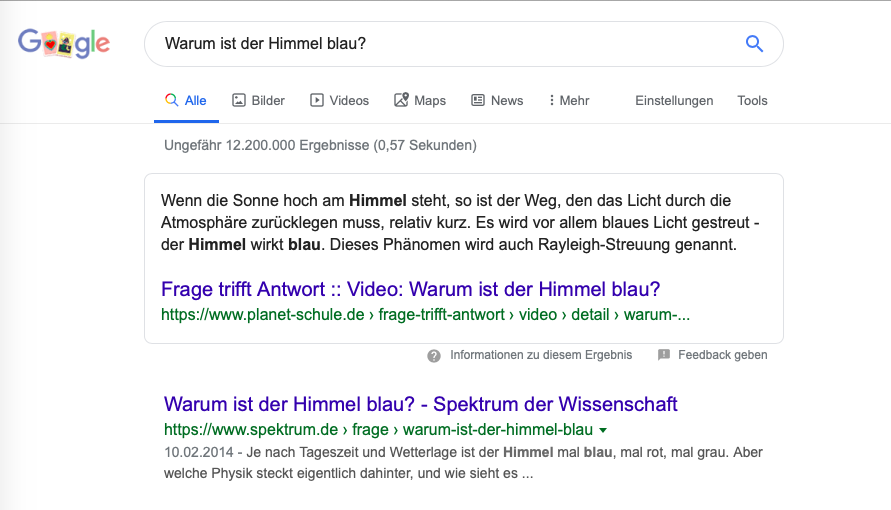
In unserem Blog findest du, zum Beispiel hier, wertvolle Tipps, mit denen du die Chancen deiner Website auf eine Platzierung in den Snippets erhöhst.
{{divider}}
5. Backlinks increase authority
The importance of backlinks will not diminish in 2020. Without relevant content, you will not receive any backlinks. And without backlinks, the first page of Google SERPs will remain a distant dream for your website.
Inbound external links from high-authority domains that link to your site simultaneously improve your website's authority, drive traffic, and thus improve your position in search results.
The most natural way to obtain useful backlinks in 2020 is still through compelling content. We explain how to create this in our free white paper. You can download it here here.
{{divider}}
6. Optimize Google ranking for local searches
Not only are more and more users using their smartphones (keyword: voice search) to find businesses in their area, but Google also returns different results depending on location.
In addition to a keyword strategy that includes your city and region, the following measures will also help improve your ranking in local search results:
- Activate a Google My Business profile.
- Use the Google Posts feature to create relevant content there.
- Register with local business directories.
- Have your own content and products reviewed with online reviews.
- Create a local landing page optimized for city, state, and zip code landing page.

{{divider}}
7. Certificates, duplicate content, and redirects
Google already classifies unencrypted pages as unsafe sources. It is likely that this will become even more stringent in the future. An SSL certificate for your website will become essential in the long term if you want to achieve or maintain a good position in the SERPs. You can keep your HTTP page, but you should set up a redirect to the HTTPS page.
In this context, ensure that Google does not interpret the content of the two domains as duplicate content. The main cause of duplicate content is the parallel existence of several versions of one and the same website. Google could evaluate URLs such as http://webseite.de, https://webseite.de, http://www.webseite.de, and https://www.webseite.de as four different web pages with the same content.
This problem can be prevented with the right redirects.
{{divider}}
8. Utilize visual search behavior
Within a year, Google Lens was already able to identify over a billion objects. Pinterest recorded more than 600 million visual searches just one year after launching its Lens tool.
Image and graphic SEO is essential for ensuring that your website, blog, or article is easier to find in Google image searches. This is because Google ranks domains with high authority, newer or current content, and images as a central element in a prominent position as more relevant.
Quality, file names, and alt tags are becoming increasingly important for SEO. You can find out what steps you should take to optimize your images, photos, and graphics here.

{{divider}}
9. Optimization based on search intent of (existing) content
Google and other search engines have long since moved beyond exact keyword matching. With the advancement of semantic search and algorithmic AI, crawlers no longer need a 1:1 word sequence in search and keyword phrases to match content with search intent. Instead, search engines place much more emphasis on context in order to understand the intent behind a search query.
Optimizing for search intent is not just an SEO measure for new articles on your blog or website. It is also ideal for reworking existing content. This allows you to kill two birds with one stone.
Google still likes to see updates and dynamic content in 2020.
{{divider}}
10. Content is king
All optimizations, whether for image search, voice search, or improving domain authority, are based on one factor: quality content. What Bill Gates already knew in 1996 is now more relevant than ever in terms of semantics and NLP in modern search engines: content is king.
So take these optimization approaches and strategies to heart to improve your Google ranking. But don't do so at the expense of the quality of your content!