Summer sales, Oktoberfest, and Black Friday are fixed dates in most companies' marketing plans. They often feature special discount campaigns. These are undoubtedly important for attracting customers and drawing attention to offers. However, beyond the traditional promotional days, seasonal content could be a little more creative from the customer's perspective.
Create seasonal content that sets you apart from the competition and offers your target audience real added value. Which topics and categories are of interest to your potential customers, and which format is most suitable? Are there special days and periods during the year when you can stand out from the crowd with your seasonal content and offer your customers something extra?
Read my latest blog post to find out how to put together an effective seasonal content marketing plan for 2019, step by step!
{{divider}}
Fact check: how to make your content marketing predictable!
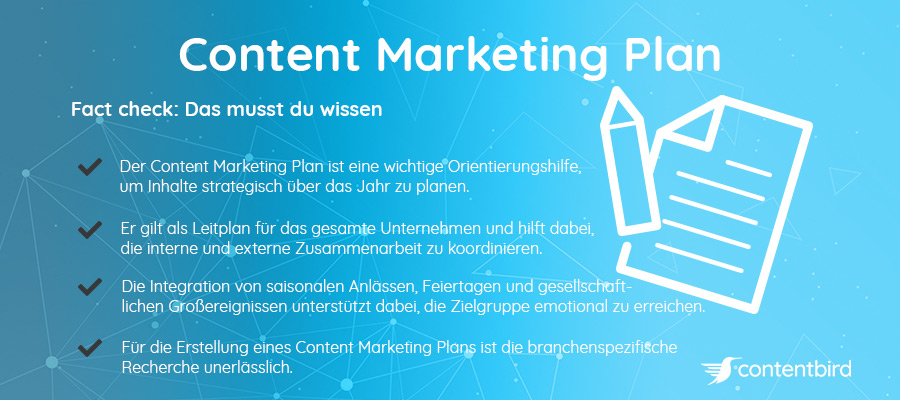
Your content marketing plan for 2019 should:
- think outside the box
- be easy for everyone to understand
- be controllable and traceable
- can be easily adapted to new requirements
- be complete and contain all relevant aspects
- be usable as a means of communication in teams
- Focus on countercyclical communication to stand out from the competition.
- remind you of important marketing events in your daily work
- also includes important industry-specific events and milestones
- Leave room for extraordinary and varied marketing campaigns
- Responsibilities include
{{divider}}
Strategy for the year: the seasonal content calendar
If you want to fully exploit the success potential of your content marketing, it is essential to prepare strategically for the coming marketing year. Depending on the industry, a content calendar is a mixture of specific dates, such as the beginning of spring or Valentine's Day, and longer periods, such as the camping and barbecue season. Does your company sell camping accessories? Then take advantage of the start of the festival season at the beginning of summer to publish a series of recipes, such as "The 10 most delicious one-pot pasta dishes for camping," or provide a practical packing list for the next big music festival as a download.
Of course, certain seasonal events and holidays repeat themselves. This is illustrated, for example, by the clear diagram from suchradar.de:

Image source: Website suchradar.de
That's why you should also take a look at the trends and developments of recent years before planning the seasonal content calendar for your brand. Google Trends makes it easy to identify changes in demand specific to your industry and identify new important topics for your content marketing based on search volume.
Important: Try to think emphatically and put yourself in your target audience's shoes. What concerns them, what are they looking for, and what solution can you offer them?
Create high-quality content that attracts attention and highlights your expertise. Right from the start, set specific days of the week on which your brand will regularly report on new topics or share insider information.
Heat or freezing cold: content about current (extreme) weather conditions encourages interaction. There's no getting around it on other emotional days either. Who could ignore "World Kiss Day" in their news feed? There are also plenty of quirky holidays that perfectly match your brand's personality. New ideas, but where to put them? Editorial or topic plan?
{{divider}}
Editorial plan vs. topic plan: what are the differences?
In order to publish your target group-specific quality content at the right time and in the right place, structured content planning is essential. An editorial plan is a must for professional content marketing.
As the saying goes: Good planning is half the battle! The editorial marketing plan is usually presented in tabular form and contains important key points about the planned content. Advice article or explanatory video? Blog post or podcast? Which channel and who is responsible for creating it? All this important information should be included in the editorial plan and made available to everyone involved in the process in its current form.
Contents of a content editorial plan:
- Date of planned publication
- Author/Responsible party
- Title of the article/blog post
- Content format (blog post, e-book, infographic, interview, DIY video)
- Current status
- Deadlines (submission before publication date)
- Defined target group
- Blog category
- Channel (blog, YouTube, Facebook, LinkedIn group, etc.)
- Call to action (newsletter, download white paper, contact)
- Main keyword, important hashtags
- For texts, the planned word count
Topic plan: Source of ideas for your editorial plan
All content ideas that fit your defined marketing goals belong in the topic plan. It is, so to speak, the collection point for all topics, headlines, and post ideas from meetings or brainstorming sessions. The dates for the planned publication are left out.
The aim here is to systematically categorize ideas and organize them clearly. Videos from competitors, statistics on media usage, ratings for TV series, or press reports: the content topic plan gives you a quick overview of all relevant news and developments. Depending on your needs, you can incorporate the content of the topic plan into your editorial plan and assign appropriate deadlines.
Every new content idea is welcome. Who knows, if not for this year, maybe it will be just right for your company next year? With our contentbird platform, you get a helpful tool for finding new topics and creating customer-relevant content. Learn how to use our W-question tool and the Keywordhunter to find out what's bothering your customers and what solutions they are looking for online.

{{divider}}
7 steps to an efficient seasonal marketing plan
# Step 1
Define a content marketing strategy that includes a profile of the market's strengths and weaknesses, as this will form the basis for all your actions!
# Step 2
Identify the target groups and personas you want to reach. Take a look at what content they prefer to consume and where they consume it online!
# Step 3
Now set your communication and business goals for the year. Do you want to improve your reputation, gain new fans, or increase your newsletter subscribers?
# Step 4
Research seasonal topics and events that are off the beaten track and that you can use for your content marketing. How about "World Soap Bubble Day" or "Name Your Car Day" to attract attention? Enter the selected dates in your editorial calendar and research suitable keywords and hashtags.
# Step 5
Define deadlines for content creation, including responsibilities. If you lack internal resources, you should seek professional help from external service providers.
# Step 6
Determine formats and channels for publishing your unique content.
# Step 7
Evaluate interactions with seasonal content at regular intervals and make adjustments to your marketing plan if necessary.
Marketing planning for an entire year – that's a tough nut to crack. All those responsible are usually happy when the plan is in place and it's time to prepare the first campaigns. What can you do to keep track of each season? With our new calendar feature, contentbird now gives you the right tool to plan your seasonal content precisely and not forget any important deadlines in your everyday work.
You can conveniently collect all the necessary information and new ideas with a single click and make them available to your authors. To ensure that your content hits the mark with your target audience, you have the option of storing your content marketing strategy and a detailed copywriter briefing. This means that all project members are on the same page from the outset, saving you tedious rounds of corrections and discussions.
{{divider}}
Conclusion
Less actionism, more structure and clarity. At every single step of the process. Is that your big wish for 2019? Well, with a sophisticated seasonal content marketing calendar, that should definitely work! If you need help with your brand, you know where to find us!