To understand the importance of content marketing, you first need to know what content marketing actually is.
Content marketing is a type of corporate communication that can be marketed in two different ways. Broadly speaking, content marketing can be divided into push and pull marketing measures.
The pull strategy is considered particularly successful and cost-effective. This involves distributing content via the company's own online channels in order to attract potential customers and interested parties.
Content marketing is about offering added value and building a relationship with the target group. It is about reaching customers and prospects with entertaining, informative, educational, and useful content.
This fact is what makes content marketing so important. You can use it to generate potential customers and improve your SEO at the same time.
As a core element of any inbound marketing strategy, content marketing has established itself in recent years as both a communication strategy and an advertising measure.
From sole traders to global players, no one can deny the importance of content marketing anymore. But how significant is it in terms of numbers? And what does that mean for your marketing mix in the future?
{{divider}}
Content marketing: Its importance as a communication tool for brands
Content marketing fulfills several functions for companies. It serves advertising, customer generation, brand communication, and search engine optimization. It therefore plays a fundamental role in the marketing mix for companies.
When we talk about the marketing mix, we are referring to the four pillars on which a company's entire marketing system is based: pricing policy, product policy, distribution policy, and communication policy.
Content marketing is a core element in at least 50 percent of these areas. Depending on how you weigh your pull and push measures, it can take up a larger or slightly smaller share of the marketing mix.
Regardless of the respective weighting, however, one thing is certain:
Content marketing has long been an integral part of every communication and distribution policy. So let's take a look at the future of marketing.
CMOs agree on the importance of content marketing
If you ask 1,000 marketing managers in German-speaking countries, 93 percent of them will say that content marketing is an important part of the 2020 marketing mix. This was the finding of a survey conducted by the marketing and PR agency fischerAppelt in collaboration with Quadriga University.
For marketers in Germany, Austria, and Switzerland, content marketing plays an important role, especially in the early stages of the customer journey.
52 percent rely on the impact of content, especially in the awareness stage. 51 percent also trust in it during the interest-building phase, and 40 percent still let their content do the convincing.

On the one hand, this also means that too many marketing managers are missing out on opportunities by neglecting content marketing in the other phases of the customer journey.
On the other hand, this also means that content marketing has found a permanent place in the toolkit of experienced marketing professionals. And rightly so:
Interesting content wins over users, followers, prospects, and customers
US marketing strategist Ross Simmonds has compiled some interesting figures that prove that content marketing works.
Companies that integrate a blog into their website and regularly feed it with useful content can increase the indexing of individual pages by an impressive 434 percent.
Simmond's core business is B2B companies, which is why he has fairly reliable figures from this sector in particular. According to these figures, a business can generate 67 percent more leads per month with a well-designed blog than brands that do not blog.
Case studies are particularly effective in this context—at least, that's what 64 percent of the B2B companies surveyed said.
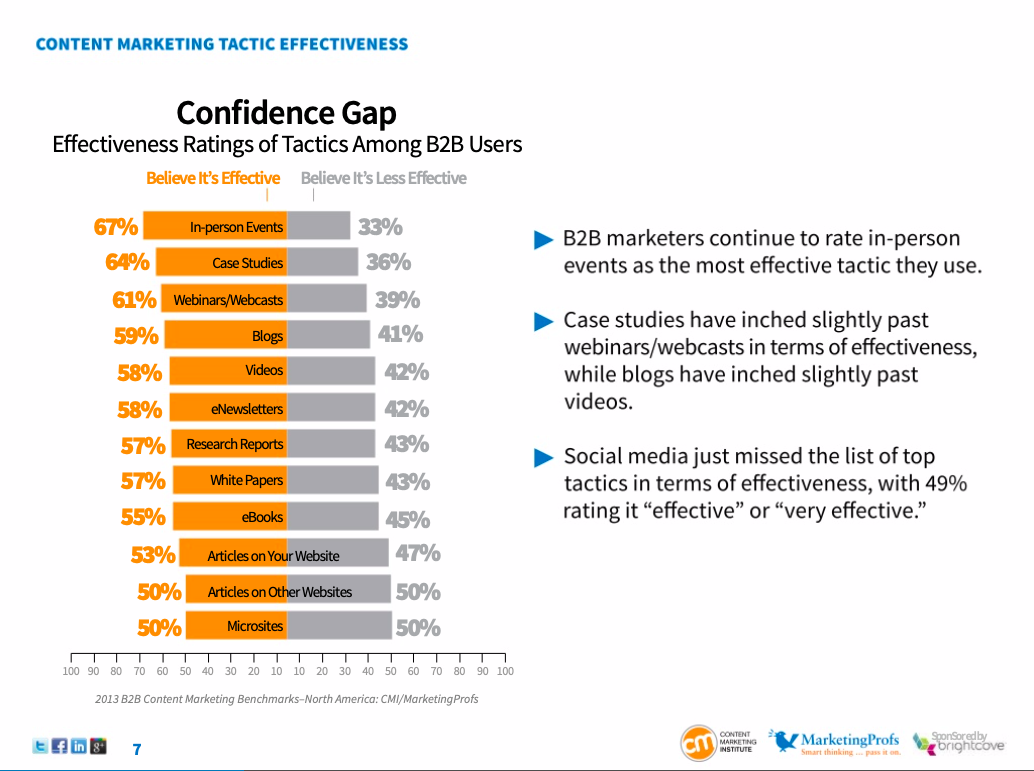
Last but not least, good content also has an impact in the B2C sector. For customers and prospects , content with added value is one of the top three reasons why they become followers on social media such as Facebook and Twitter or subscribe to a newsletter. And why is that?
Content is informative, useful, entertaining advertising.
This means that content marketing works better than advertisements or banners. Matthias Wesselmann from fischerAppelt knows that German consumers have no problem with content marketing as long as companies are transparent about it.
So if a blog article or video is not disguised as independent, but clearly communicates who the content comes from and how it relates to the brand, business, or product.
According to contentbird's findings, this does not prevent 70 percent of people from finding out about content pieces.
This is because they simply offer better opportunities to engage intensively with a product than other online advertising. It is therefore not surprising that companies achieve eight times higher conversion rates through content marketing than through other marketing channels.
And all this at 62 percent lower costs than other marketing measures incur on average. So while you save money with content marketing, you can also make a profit on your revenue.
However, it is not just the figures that argue in favor of giving content marketing a place in the marketing mix of the future.

{{divider}}
Content marketing: Importance for SEO
Content marketing measures not only fulfill the goals of customer generation, sales growth, and reach improvement. With content marketing, you can also achieve the goal of better visibility in SERPs. This is because a blog, a Facebook group, regular posts, and shares by your followers improve your ranking in the long term.
Since Google's algorithm increasingly emphasizes added value, sustainability, timeliness, and reader benefit, content pieces that fulfill these aspects are rated more highly.
Google rewards content that is read, commented on, and shared frequently. Of course, even the best content cannot replace on-page SEO and keyword analysis. However, when combined with these elements, it significantly improves your chances of achieving a good ranking.
The formula is very simple: the more good content you provide, the better for your SEO. And the better your SEO, the more traffic, leads, and customers you can generate.
{{divider}}
Always focusing on the target group
With increasingly smart and sophisticated algorithms, customer centricity is becoming more and more important in content marketing. Marketing experts surveyed by fischerAppelt in their 2018 study are also aware of this.
Nearly 60 percent rely on their own data to define their target group. To do this, they primarily use surveys of their customers and values from analytics tools.

It is important to understand and identify your target audience. With this knowledge, you can optimize your content even further. This, in turn, will help you achieve the goals you want to achieve with your content marketing.
And so we come full circle, right back to where we started: customer focus.
{{divider}}
Give your content marketing significance in your marketing mix
Content marketing is a key control for all your marketing activities. Valuable content is not only great advertising for your business, your brand, or your product. With good content, precise customer analysis, and a suitable strategy, you support
- your SEO and increase traffic, visibility, leads, and conversions,
- your social media management by seeding articles, videos, and graphics across platforms,
- Your push marketing measures, such as pay-per-click: The number of hits and responses to your content can help you select topics, keywords, and search terms for ads.
But content marketing is not an invention of the technological age. It has a long history and development behind it, from one-page advertisements in print magazines to brand-owned customer magazines, blogs, micro-influencers, and collaborations.
What does this teach us? That content marketing already existed long before there was a definition for it and it became a buzzword.
However, it also proves that content marketing has always been important in corporate communications and has become increasingly effective and relevant since its early beginnings as a customer magazine published by John Deere.
How can you use content marketing to make your marketing mix fit for the future? The contentbird white paper reveals all. Download it for free and benefit from helpful examples, checklists, and insights.