
Editorial Agent: from brief to fact-checked draft
In many teams, the first draft takes up most of the time. Raw AI text often lengthens the approval loop instead of shortening it, because someone first has to make it usable.
That's why the Editorial Agent doesn't deliver raw text but a structured draft: an outline built around search intent, copy in your brand voice, an FAQ block, metadata and verified facts. Anything that can't be backed by evidence gets flagged instead of asserted.
Six skills belong to this agent:
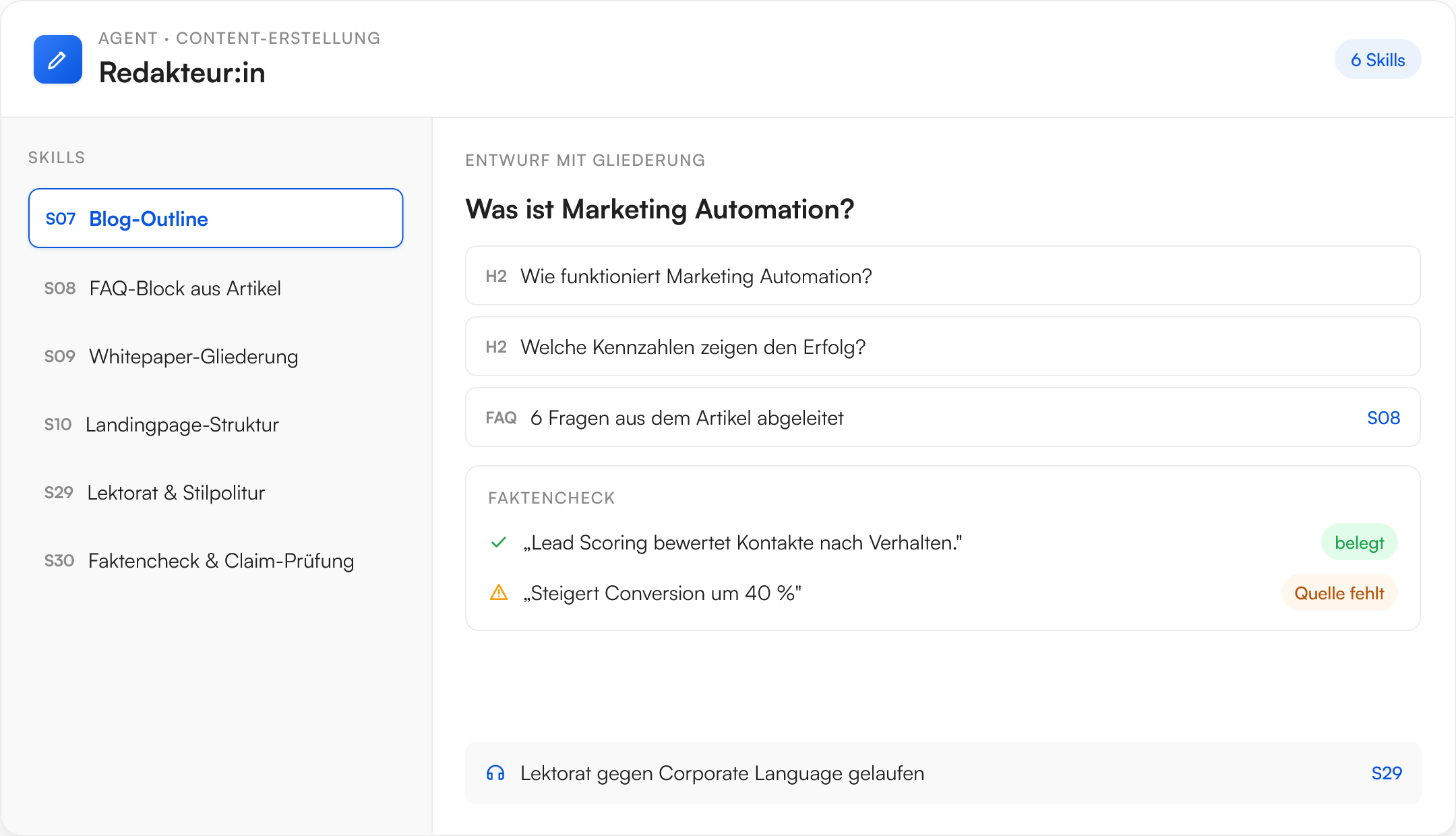


What the Editorial Agent takes on
- Blog outline and FAQ block
An outline built around search intent, plus an FAQ block that answers the follow-up questions from the article. Both increase the chance of appearing in search results and in AI answers.
- Whitepaper and long-form outlines
Longer formats get a structure that holds up, instead of a string of loosely connected sections.
- Landing page structure and copy
Structure and copy for landing pages, tailored to audience, offer and conversion goal.
- Copy editing and fact-checking
Style polishing against your corporate language and an evidence check for every claim. The draft enters the workflow ready for approval instead of triggering another round of corrections.
The six skills of this agent
Blog outline, FAQ block from an article, whitepaper and long-form outline, landing page structure and copy, copy editing and style polishing, fact-checking and claim verification.
See the Editorial Agent live
What's built into every agent

Context first
Project knowledge and corporate language come before any best practice.
Results are built on your knowledge, not on industry clichés.

Quality as a mandatory loop
A seven-step review loop with self-check runs before every output.
The result is a draft ready for approval, not raw text.

Boundaries and evidence requirements
Anti-hallucination rules, mandatory sourcing and legal flags are built in.
Anything that isn't backed by evidence gets flagged instead of asserted.
