Google addresses the motivation that drives people to use the search engine in its latest commercial with the words: "Every search takes you further."
What exactly it is that drives you or what you want to "get on with" varies greatly from person to person. Maybe you want to find your way to a restaurant where you have an important dinner date or you want to find out about that further education course you've been thinking about for so long. Whatever you want to do, every search query is based on an intention.
Meeting this search intention is Google's goal and therefore automatically one of the most important factors for successful search engine optimization, because only if you understand the search intention and manage to serve it will you create real added value for users and your website will be classified as relevant by Google, which in turn has a positive effect on visibility.
In this article, you can find out how to recognize the search intention behind a keyword and what the different types of search queries are.
{{divider}}
What you can expect in this article
- Search intention and user intention
- Keyword types
- Types of search queries
- SERP-Analysis
- Mixed Intent and secondary search intentions
- Practical examples
{{divider}}
Search intention and user intention
To make it clear what exactly is meant by search intent, the article starts with a definition of the terms.
In short, search intent is the intention with which a specific keyword is entered into a search engine such as Google. The user intention is the overriding motivation behind it.
So in order to do justice to the user intention, there is no way around the search intention, because every user intention necessarily goes hand in hand with a search intention.
{{divider}}
Keyword types - the basics
There is a specific intention behind every keyword. Finding this out is sometimes not so easy, because a user reduces a potentially complex thought process to just a few search terms by entering them into Google. Nevertheless, keywords are the means of communication between the user and Google and therefore the best way to understand the user and their intention. For this to succeed, it is helpful to know the different keyword types and to be able to classify them correctly.
Keyword types: transactional, informational & navigational
The division of keywords into transactional, informational and navigational is a popular classification model. Depending on the category, different content is then required on your website in the next step.
Informational keywords
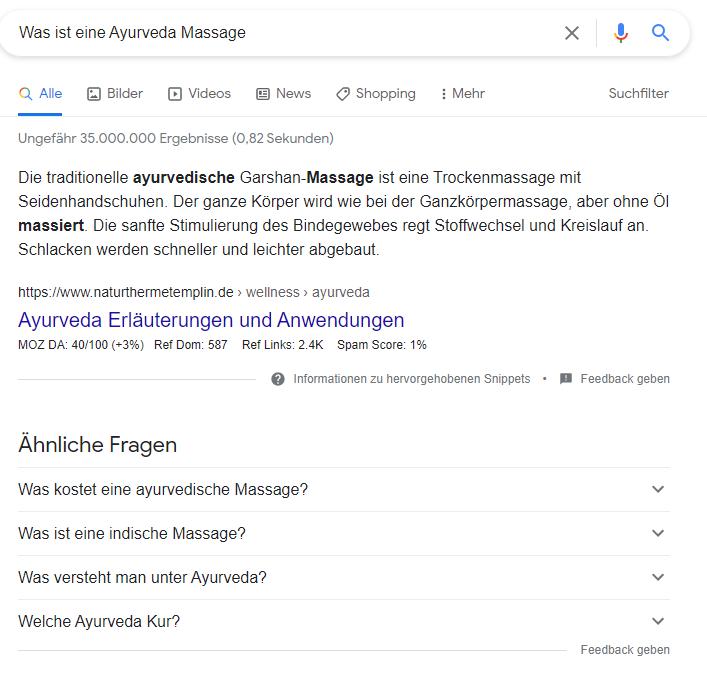
Informational keywords are search terms that users use to find out more about a specific topic. If you decode a keyword as an informational keyword, you should provide information on your website. Depending on the subject area, this can take the form of detailed guides, checklists, instructions, etc.
Informational keywords examples: "What is an Ayurveda massage?" or "What is curd soap made of?"
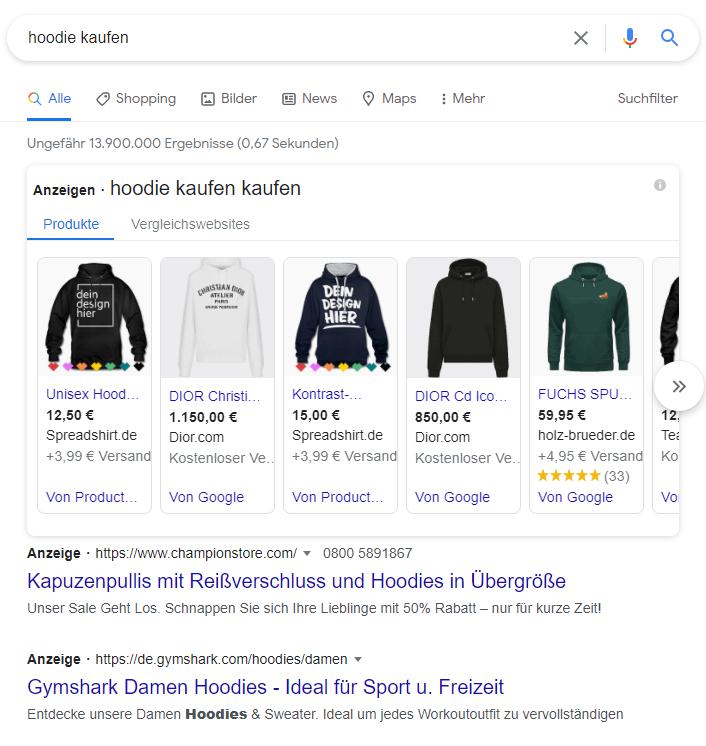
Navigational keywords
If the user uses navigational keywords, for example, they want to be navigated to a specific page or brand.
Navigational keywords examples: "Lord of the Rings Netflix" or "Hikes Munich Komoot"
Other keyword types
In addition to transactional, informational and navigational keywords, there are other ways to classify keywords. By differentiating between brand keywords, compound keywords, W-question keywords and long-tail keywords, you can become even more aware of the type of keyword. And the better you understand the keyword, the easier it is to understand the user and recognize their motivation.
- Brand keywords are keywords with which the user searches for a specific brand, for example: "Adidas"
- Compound keywords combine several keyword types, for example: "buy Adidas pants" (brand and commercial)
- W-question keywords are search queries that begin with Who, How, Where, What or When, for example: "Who is Bud Spencer?"
- Long-tail keywords are long and specific keywords with a usually very low search volume, for example: "45 minute Ayurveda massage Munich and surroundings"
Types of search queries
The different types of search queries are closely related to the keywords. Basically, 4 types can be defined:
Do requests
The category of Do requests includes any type of request that should end with an interaction, for example a newsletter subscription. Do requests are therefore closely linked to transactional keywords.
Buy requests
Buy queries are geared towards a specific action, namely the purchase of a specific product. The commercial keywords can therefore be assigned here.
Go requests
Go queries lead the user to a virtual or real location. This includes the category of navigational keywords.
Know requests, including know-simple requests
Know queries are used to obtain information. The appropriate keyword type is informational keywords.
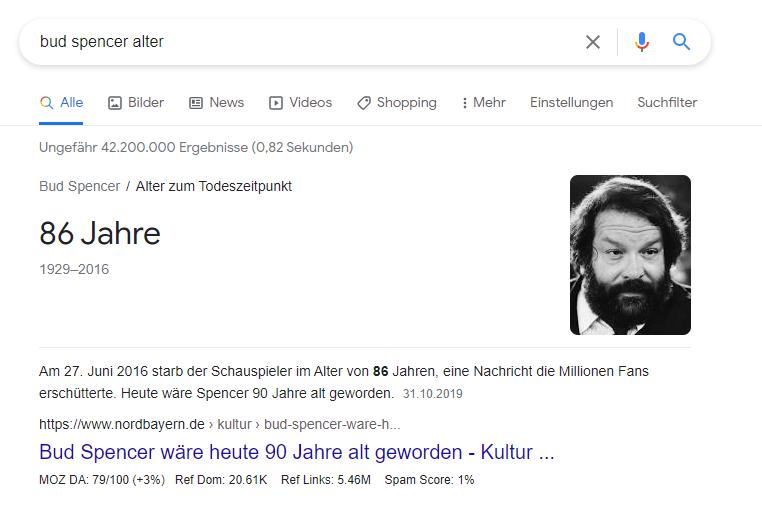
With know queries, a further distinction is made as to whether the user is looking for comprehensive information on a specific topic or just needs quick information or an explanation of a term (know-simple query). These quick explanations of terms are often already answered on Google itself and therefore do not bring any traffic to your own website (see the example of Bud Spencer's age).
{{divider}}
SERP analysis
Google search itself is the most valuable tool for understanding the search intention behind a keyword. Because only what is well received by users will have a chance of being visible on Google in the long term.
So take a close look at the top results for the individual keywords and try to find out which intention is served by the result. The keywords used in the snippets, but also the position at which elements such as shopping results, videos or an info box are integrated, provide information.
Analysis options in the SERPs:
- Snippet analysis: Which other keywords can be found in the title tag and meta description?
- Where are individual elements such as videos, Google shopping results etc. to be found?
- Google Knowledge Graph or Infobox: What key information on the topic is crucial?
- Google Maps result: Does the location matter?
Mixed intent and secondary search intentions
Unfortunately, search intent is not always as clear in practice as it is in theory. Mixed intent, i.e. several interests behind a keyword, one or more secondary search intentions or a possible change in user needs are just some of the examples that need to be taken into account when classifying keywords. A little sensitivity is required here. By putting yourself in the user's shoes, you can best identify and interpret possible ambiguous search intentions.
Even for Google, the search intention is not always clear. This makes it all the more important to think about delivering a result that the search engine classifies as relevant.
{{divider}}
Practical examples
Practical example "Frisian mink"
There are two possible search intentions for the keyword "Friesennerz":
1. Informational (marked green)
2.Transactional/commercial (marked red)
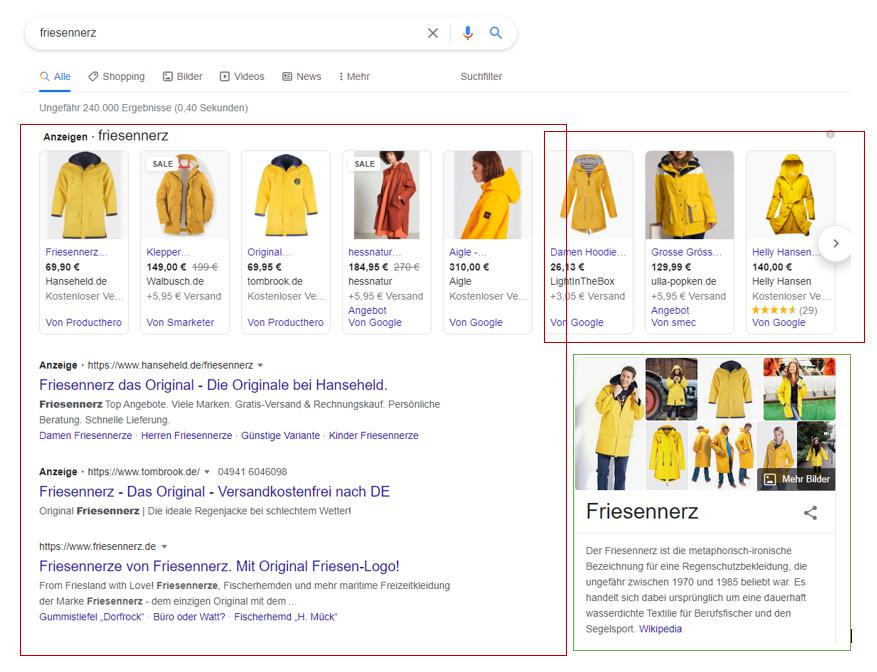
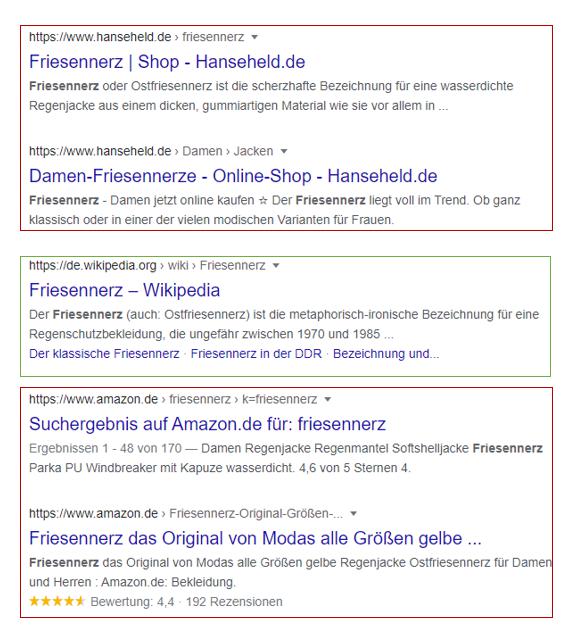
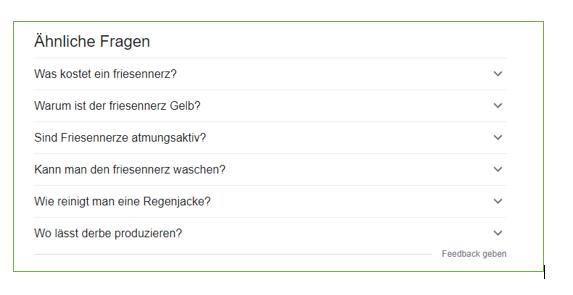
The search results on Google show that, in addition to the intention to buy, users are looking for more in-depth information on the topic of Frisian mink, otherwise the informative pages would not be so high up on the search results page. In order to rank well for the keyword "friesennerz", you should therefore not only provide a store with products, but also information about the Friesennerz.
Practical example "fly swatter"
There are also two possible search intentions for the keyword "fly swatter":
1. Informational (marked green)
2. Transactional/Commercial (marked red)
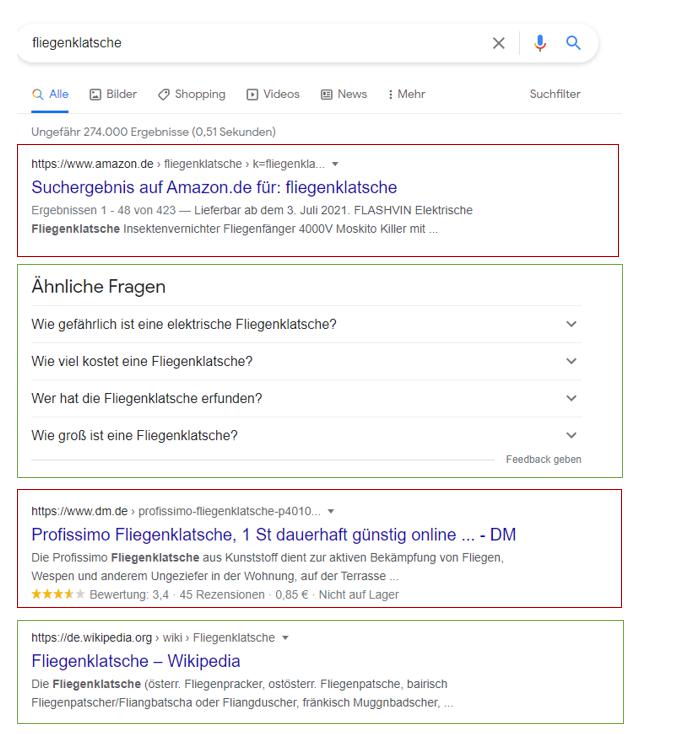
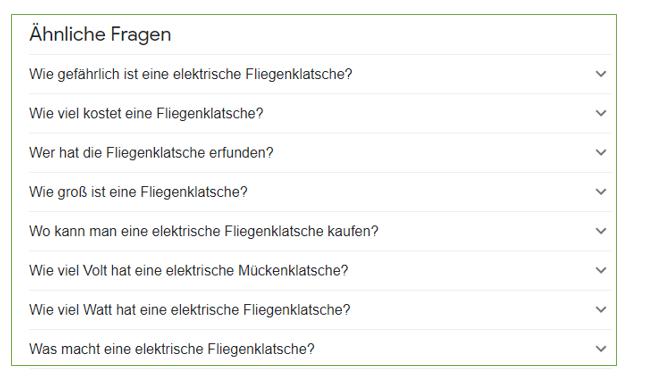
In addition to the purchase intention, information also plays an important role with fly swatters. For example, users want to know how dangerous an electric fly swatter is or who invented the fly swatter. Many keywords can be derived from the "Similar questions" feature box in particular, which can be incorporated into your own website in order to cover the search intention in the best possible way.
{{divider}}
Analysis of the top websites
In addition to the search results, you should also take a close look at the websites of the top search results in the next step. Because only by analyzing the websites can you find out what the competition is doing right to serve the search intent. However, you should not simply copy the top websites. There may be important points that the competition is still missing and that could in turn give you an advantage in the rankings.
When analyzing the website, it is also very important to put yourself in the user's shoes. For example, you can ask yourself what you would want as a user in order to get along well on the site. For example, is the information you need available or are there enough call-to-action buttons in the right place?
Tips for website analysis
- Open websites in parallel in several taps
- Compare similarities and differences
- What is still missing even in the top 3 search results?
- Derivation of the most important element to meet the search intention
- Putting yourself in the user's shoes
{{divider}}
Analysis of user signals
User signals are an important ranking factor. This is because user signals such as click rate, bounce rate, dwell time, etc. enable Google to understand whether the website is helpful for users and whether they will find what they are hoping to find through the search.
If the users are satisfied, Google is also satisfied, because the users will return to Google again next time, which increases the importance of the search engine and thus increases advertising revenue through Google Ads.
It should therefore be clear that search intent is directly related to user satisfaction and therefore also to Google's evaluation of your own website. Analyzing the user signals of the website can therefore also be a good way to check its relevance for users.
{{divider}}
Conclusion
In order to understand the search intention behind a keyword, it is helpful to be aware of the different keyword types and types of search queries. Keywords should also be checked for ambiguity.
An informative first step is to analyze the SERPs. The first page of the search results already reveals a lot about the user intention. In the next step, the highest-ranking websites should also be analyzed in order to best meet the search intent, but also to find possible topics that the competition is still missing.
A deeper analysis is not possible without keyword tools and an analysis of user signals, but the free options in Google Search itself should never be underestimated, because ultimately this is where you want to see your website in the future.
Another important keyword is empathy. Ultimately, Google users are just people like you and me who use Google search on different devices every day. Be aware of what motivations, expectations, hopes and doubts could be driving the user and you will also understand the search intention.