"If you can't measure it, you can't manage it."
That's why content marketing remains a skill without performance analysis. Content tracking enables the calculation of value and optimization of digital content. But no one needs a 20-page report. Content tracking not only makes digital content measurable, but also has the task of mapping the company's strategy. Only through the systematic selection of KPIs can these become an efficient control logic.
{{divider}}
What is content tracking?
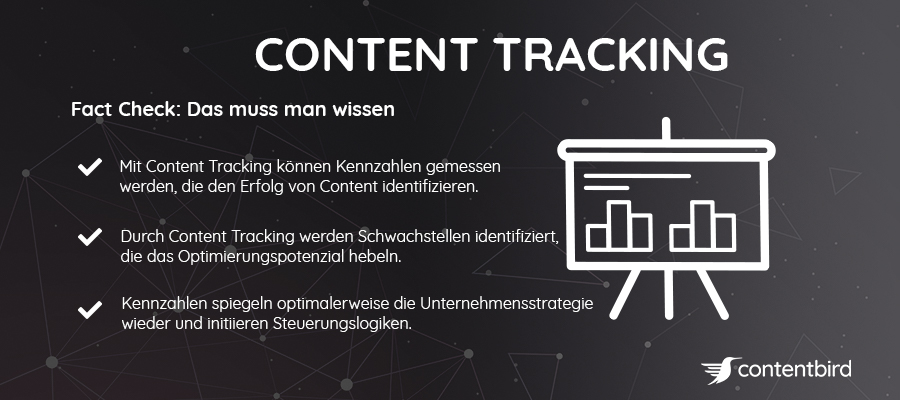
Content tracking refers to the measurement of key metrics that indicate the success and optimization needs of content. Content tracking offers the opportunity to identify the quality and performance of content. By identifying performance indicators, optimization potential and thus performance can be significantly leveraged.
To perform an efficient performance analysis of your own content, a content marketing platform with an integrated analysis component is ideal. Content tracking is a fundamental feature of the contentbird platform. It shows you the value of your content and whether the resources invested have paid off. You can see the most important metrics about your content at a glance and thus fully exploit your optimization potential.
{{divider}}
Your SMART goal must be clearly formulated!
The company's goals must be optimally represented and measured in an analysis tool. Every website is unique, and its content tracking must be just as unique. While online shops typically focus on conversion and bounce rates, corporate blogs require qualitative analysis.
Content managers often want to know more precisely:
- Which author achieves the best results?
- Which posts and categories are read most frequently?
- How many words should a post contain?
- How do I research suitable keywords and W questions?
- What is the value of the published content?
- Is high-quality content more cost-effective than paid ads?

There are countless key figures and metrics that you can evaluate based on the data generated by your content. However, instead of dealing with all KPIs, it is worth defining a SMART GOAL. Why? Every SMART GOAL has different drivers. These drivers tell you which performance indicators are important for your strategy. Poor key performance indicator systems run the risk of having only limited relevance for management. The main reasons for this are excessive information, a lack of future relevance, and a lack of impetus for decision-making.
Note: The company's strategy is reflected and measured in key performance indicators (KPIs). Control logic is derived and promising impulses for decisions are identified.
{{divider}}
Key figures for content tracking
Content tracking serves to optimize existing website content. It identifies the weak points of the website. This allows indicators to be found that show whether content should be optimized or not. Important metrics for measuring the success of a website are:
Reach: Reach refers to all unique page views (unique visitors).
Bounce rate: Bounce rate is the percentage of visitors who only view a single page.
Conversion rate: Conversion rate indicates the ratio of visits to conversions. A conversion is a previously defined and achieved goal (usually a purchase or transaction).
Dwell time: Dwell time indicates the average amount of time a visitor spends on a website.
Organic visitor count: The organic visitor count indicates the number of visitors who arrive at the website through organic search results.
Traffic value: Trafficvalue indicates how much money would have been spent on organic visitors in AdWords, i.e., how much the content is worth.
Content ROI: Content ROI shows whether content has already paid for itself.
Ranking: The ranking indicates the position of a piece of content in Google's organic search results.
{{divider}}
Quantitative optimization potential vs. qualitative optimization potential
Weaknesses in content can vary in nature. Sometimes the content is enriched with precise assets but poorly written. Other times, the tone is exactly right for the target audience, but the content looks like a wall of text. A content audit therefore distinguishes between quantitative and qualitative optimization potential. Find out more in the article "Content audit as the basis for content optimization" to learn how to implement your content audit and turn historical content into diamonds.
Quantitative analysis looks at frequencies. How often do you use primary and secondary keywords, how many images and graphics are included in the post? Quantitative analysis includes a kind of inventory list in which you compile all relevant key data about the content (including URL, title, date, content type, format).
Qualitative analysis, on the other hand, examines the content from a substantive perspective. This reveals the editorial standards applied to the article. The KPIs considered include readability index, writing style, readability, and engagement metrics.
{{divider}}
A dashboard helps you keep track of everything
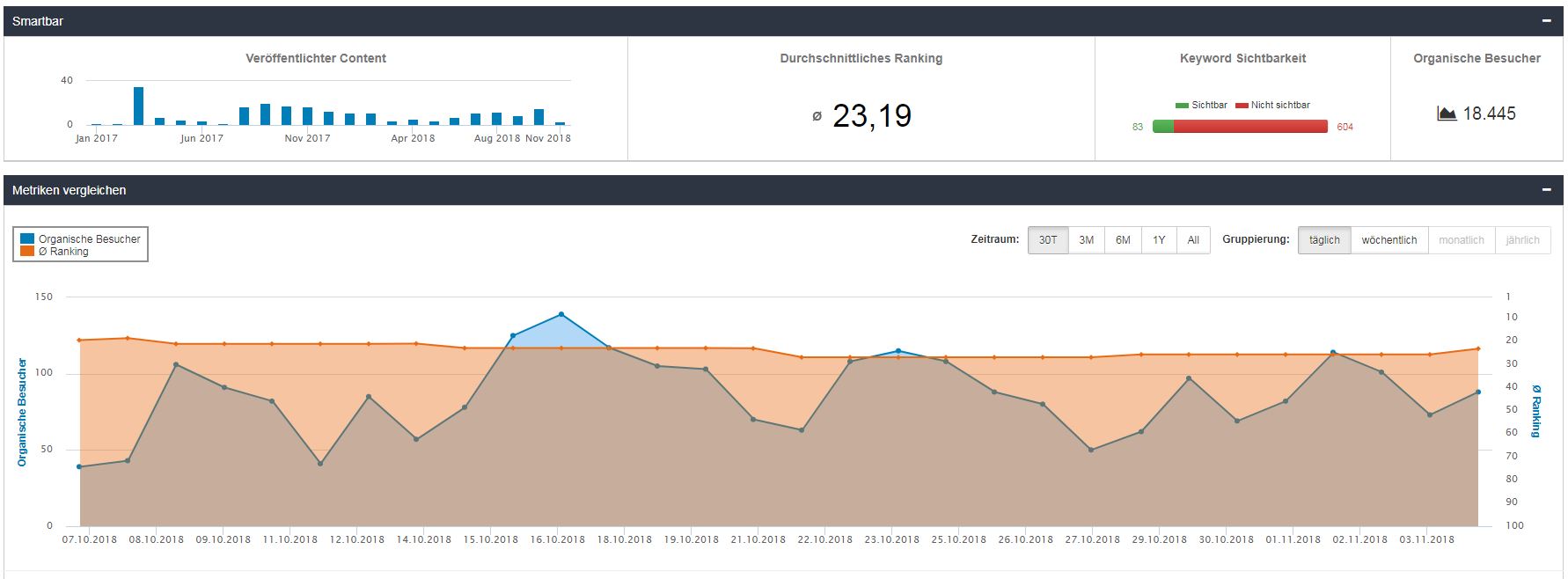
Reports need to be presented clearly. Visually prepared data is not only easier to comprehend, but also more effective in persuading the CEO. Graphical representation on a dashboard provides all important key figures at a glance. Data can be correlated more easily. Conclusions and optimizations can be identified efficiently. You get an overview of the winning and losing content. Often, such an overview already helps to identify the reason for enthusiasm and rejection.
The blog monitoring dashboard is also an important tool for team dynamics. A glance at the morning report motivates employees. Concrete evaluation of "what one's own work" achieves provides impetus that can have a positive effect on teamwork. It doesn't matter whether this is done in Google Analytics or a connected tool. It is important not to banish data analysis from the content marketing team, but to see it as part of the whole.
{{divider}}
Content tracking makes content marketing success measurable. But it goes one step further and reveals potential for optimization. This makes key performance indicator systems the most important basis for identifying and optimizing digital content. Here's how to implement content tracking optimally:
Step 1: You perform a content analysis to ….
- identify the most frequently visited content
- Identify articles that convert well
- Find posts that do neither of these things
Step 2: You conduct a potential analysis to ...
- Identifying content that needs to be updated
- Identify posts that should be deleted
- Finding articles that are great and don't need optimization
{{divider}}
How to track your content with contentbird?
The analysis part of the contentbird platform is an essential interface for measuring success and re-optimizing existing content. The graphical display provides you with an optimal summary of the most important performance data. This means that not only can each individual piece of content be evaluated, but it can also be revised immediately afterwards.
The success of content marketing only comes about in the workflow. And content tracking is just as important for this as content creation. A well-rounded process ensures that the control function of key figures is not lost.
Try the contentbird platform with a 14-day free trial and track your content!
We would love to hear in the comments what weaknesses you were able to identify by analyzing your content.