Convincing executives and board members of the value of your content is a real challenge. Top executives in companies often manage organizations with several hundred employees and spend more than 70 percent of their working time in meetings. Furthermore, managers have many individual motives, interests, and behaviors.
Read my latest blog post to find out how you can attract the attention of senior management with authentic content while always communicating on an equal footing. Reaching C-level decision-makers no longer has to remain an unfulfilled dream!
{{divider}}
Fact Check: What you should know about C-level communication
For most people, the executive level is a rather unknown world. This is where decisions that set the course for the company are made, often many years in advance. Top managers come into contact with many different people every day. They go from one conference to the next and receive new ideas 24 hours a day. It is not easy to make yourself heard at this level as a brand that is still unknown.
{{divider}}
What exactly does C-level mean?
This refers to the top tier of a company's organizational chart, or the "executive suite." Derived from the English job title "chief," it is now used primarily in international companies to designate the highest-ranking executives. Job titles such as CFO (chief financial officer), CMO (chief marketing officer), and CEO (chief executive officer) are now widely used. However, there are significant differences in the definition of individual areas of responsibility and duties.
{{divider}}
What concerns executives?
Without question, the need for information is extremely high. As the final decision-makers, however, CEOs are primarily interested in the following three points when choosing new business partners:
- How can your company contribute to customer growth?
- How can your brand help reduce costs in the company?
- How do your products support customer loyalty?
Increasing market share, rising sales figures, customer loyalty, and improved productivity are therefore at the top of the agenda for managers. Their goal is to optimize business results and operational processes. They search for new and better solutions for this every day. In meetings, at trade fairs, industry events, newsletters, or online via Google. In addition to the right placement of advice articles, white papers, and case studies, your content should be convincing in terms of content.
Current statistics and analyses back up what you write and give you expert status. You should address your message to a specific person. Add a catchy headline and subject line. These are good prerequisites for arousing the curiosity of a top manager with your content.
This is important for executives in communications:
Before you create content, you should know what a typical working day as a manager looks like. An analysis of executive calendars by Harvard Business School revealed that, on average, they attend more than 37 meetings per week, most of which lasted longer than an hour and thus took up more than 3/4 of their working time.
The remaining working hours are used to answer emails and other written inquiries and to find out about offers. Of course, it is inevitable that managers also devote themselves to professional matters on weekends. However, the trend is clearly moving toward using days off to relax and recharge your batteries.
C-level decision-makers therefore have limited time to gather information and devote themselves to your content.
That's why your C-level content should primarily...
- be well structured and easy to read,
- get straight to the point without beating around the bush,
- communicate content on an equal footing,
- relieve or facilitate the decision-maker's "work,"
- generate new visitors and leads,
- and contain the right solutions for customer growth.
{{divider}}
How to create quality content for CEOs?
High information density, usable facts, graphics, and statistics characterize good content for management. To make a distinctive impression, newsletters, videos, or images can, of course, be designed to be stimulating. Not as emotional as in the B2C sector, because here you should get to the point more quickly with your content and convey the right message.
Moving images are therefore particularly successful with the C-level target group. Explanatory videos are ideal for highlighting specific product features and presenting even complex offerings in a clear and concise manner. Give your brand charisma and don't just use purchased photos from image databases. The experienced CEO has probably seen this image dozens of times before at competitors.
Why should the manager choose your company for this project? Because your brand appears more trustworthy, competent, and technically proficient than the competition. If you provide the CEO with tangible content that he can use to reinforce his arguments for decisions, your content will satisfy him more easily.
Is storytelling only suitable for addressing B2C content? Far from it! CEOs also want to be entertained, depending on the situation. However, it is important to frame the stories with target group-specific case studies, infographics, or statistics in order to offer real added value at the end of the day.
{{divider}}
5 rules for successful C-level content marketing:
- Provide reliable, up-to-date insights such as market data, industry knowledge, information about new laws and regulations (e.g., in the areas of employee management or goods import).
- Use well-known speakers, influencers, or authors to give your brand a distinctive voice and position yourself as an expert.
- Work with other strong partners in the industry to create exclusive analyses or other excellent content to set yourself apart from competing offers.
- Choose the right wording, tone, and language, individually tailored to the respective target group (persona) and mood.
- Ideally, offer step-by-step solutions for long-term market success, increased productivity, and more customer growth.
Content formats that decision-makers trust
Let's take a look at the Hubspot State of Inbound Study from 2018. The study is based on responses from 6,200 respondents in German-speaking countries. According to HubSpot, decision-makers used to gather information primarily at customer events and trade shows, as well as through personal recommendations and media articles, before making a purchase decision. Today, customer references and personal recommendations are among the top sources of information at the C-level.
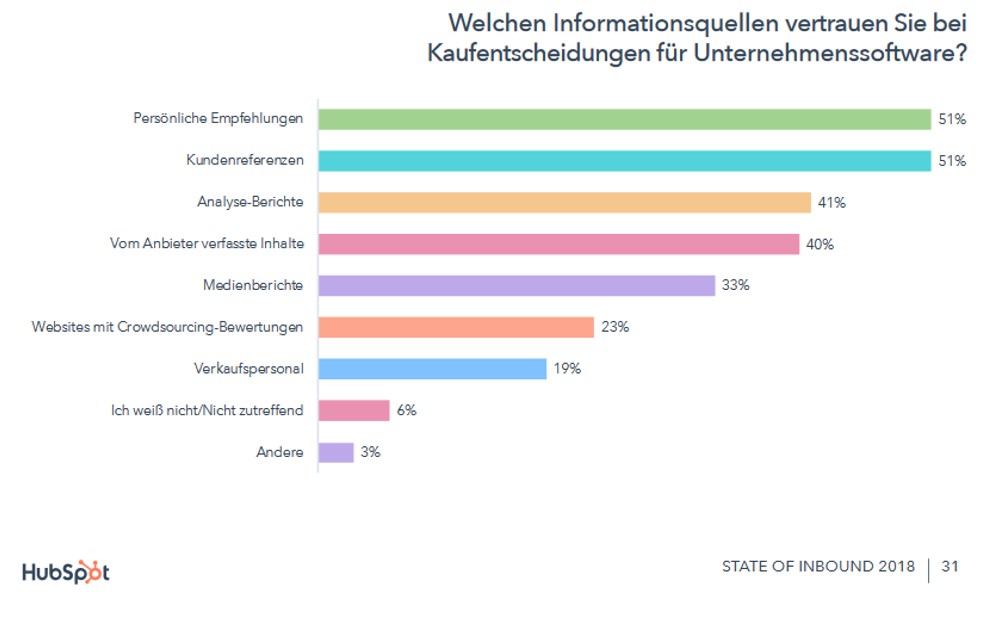
But informative analysis reports and extensively researched specialist articles are also highly valued by CEOs. According to this study, 45 percent of the board members surveyed trust content written by providers themselves, such as blog posts, white papers, or native advertising articles.
If you have been able to impress with your content through expert knowledge and detailed research, the manager will feel well advised. The decision-maker will begin to trust your unique content. A connection to your brand will develop, and motivation to visit your specialist blog or website again will increase. Later on, the decision-maker will be less hesitant to recommend your offer internally or consider you as a solution provider. This doesn't just apply to acquiring new customers. Useful content helps you to keep your customers enthusiastic about your brand.
{{divider}}
Reach C-level managers with targeted content
"Customer feedback can sometimes be painful, but it's always good." – Rolf Hansen
To tailor your content marketing campaign to the needs and moods of CEOs, you should regularly seek feedback on the content you create and engage in dialogue with management. Surveys via email or social media can be carried out quickly and easily and provide you with valuable customer insights. This allows you to accurately engage your persona with topics that actually affect them in their business.
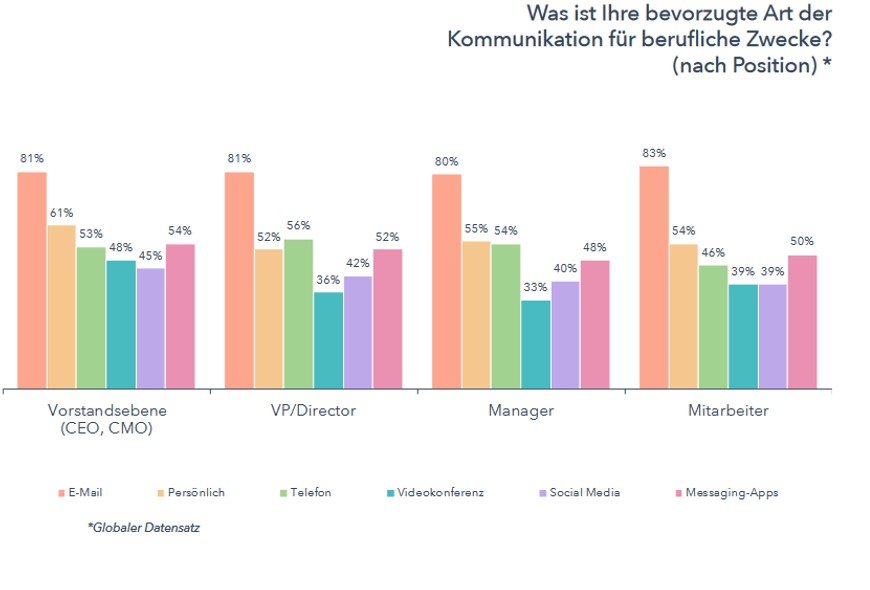
You can increase your brand's visibility with Google, XING, or LinkedIn Ads. Sponsored posts in business networks or writing articles on these platforms also support content distribution. But even in the context of native advertising, you have many opportunities to become a preferred source of information for the C-level hierarchy.
To ensure that your content is noticed in the C-level sector, it is also advisable to work with influencers in the industry. These can be well-known speakers at conferences or other recognized managers in leadership positions who are highly visible online and have a broad range of expert knowledge. Strong partnerships have always paid off, and this is especially true when it comes to creating high-quality content for a discerning target audience.
Want to finally take your content marketing to the next level and reach C-level decision-makers? In our content marketing white paper , you'll learn everything you need to know about the advantages of target group-specific content, as well as a practical explanation of the five relevant steps: content research, planning, creation, distribution, and analysis.

My conclusion
What matters most to CEOs are figures, facts, and statistics that help them make informed decisions within their companies. Successful B2B content marketing delivers these in the form of exclusive, high-quality content enriched with informative added value. Authenticity, understanding the challenges faced by executives, addressing them on an equal footing, and specialized know-how are the best prerequisites for gaining the trust of managers. This allows your brand to shine as a problem solver and will certainly be recommended to other (new) customers with a smile.