What comes to mind when I say “China”?
Now, maybe you’re thinking of the Great Wall of China, communist capitalists, or even the fun fact that people in China often go for group foot massages. These are all things that the West immediately associates with China.
What I hadn’t given a second thought to until a few days ago, however, is the Chinese internet. How could I have? After all, in Western Europe, it’s primarily Google that sets the tone for online marketers. Consequently, “China SEO” is rarely discussed in Germany.
I think it’s time to address this and delve into an aspect of search engine optimization in China that has been neglected so far: on-page content.
{{divider}}
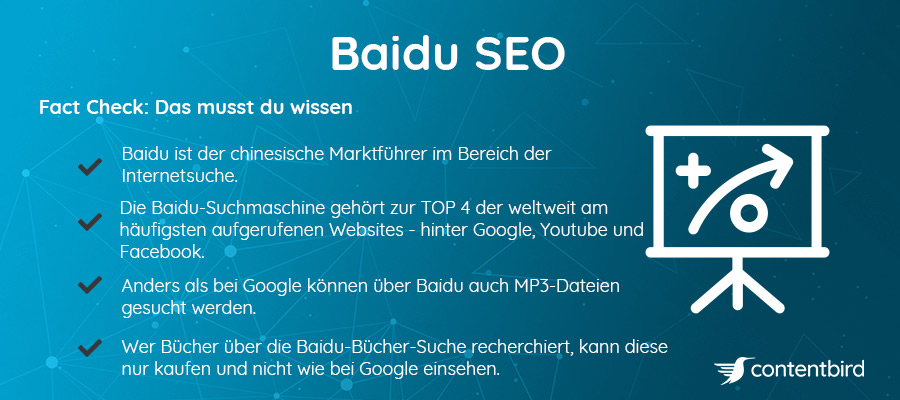
Baidu – China's Google?
{{divider}}
News, social media, and website content – Content optimization for Baidu
In China, too, the rule of thumb in SEO is: Content is king! However, this applies in a slightly different way than it does in Europe and the U.S…
If you keep the following points in mind for future optimizations, your content will appeal to both Chinese users and Chinese search engines.
Chinese is spoken in China
It should go without saying: Effective Baidu indexing depends entirely on the Chinese translation of your website content.
It is especially important that you…
- use traditional Chinese characters and
- take into account the multiple meanings of the individual characters.
The second point, in particular, is extremely important for intercultural communication! After all, if you’re misunderstood, your content obviously won’t sell anything either.
We therefore highly recommend working with native speakers who are familiar with common wordplay and linguistic quirks in general.
The same product doesn't mean the same target audience!
Simply translating your own content into Chinese would be insufficient and would not meet the needs of the target audience.
Even if you're selling the exact same product, you're dealing with two completely different markets, each with its own cultural norms.
Want an example? In China, a person’s rebirth must be approved by the government. Just one fact that impressively underscores the cultural differences of the Chinese people.
To ensure your content reaches your target audience, you should therefore…
- conduct its own target audience analysis for the Chinese market.
The Chinese don't like to copy (at least when it comes to content)
Baidu penalizes duplicate content even more severely than Google does.
According to this, stolen content has been shown to harm your ranking. Even though the Chinese are often accused of copying successful products, this clearly does not apply to content.
Just as when writing website content in German or English, care should be taken to ensure that every single piece of text…
- is unique (unique content) and
- is at least 300 words long (preferably more).
More content is better than less (and it should also be up-to-date)
In this regard, Baidu is every bit as good as its Western competitor, Google: a large volume of high-quality content has a positive impact on search rankings.
In addition, up-to-date content in a news format can also help improve search rankings. So it stands to reason…
- a blog or
- a news section
to integrate it into your own website and maintain it regularly. Ideally, this should also be done by a native Chinese speaker.
Big Baidu is watching you
The Chinese government systematically blocks searches for controversial terms. Here is a brief overview of the most important taboo words:
- Chinese Communist Party
- resign from the Chinese Communist Party
- dissolve the Chinese Communist Party
- the end of the Communist Party's rule
- dictatorship
- one-party system
- not to love the party
- Human Rights in China
- tyranny
- Government rule
- Brainwashing
- Kidney transplantation from living donors
- Nine Comments (-> a critical book about the People's Republic of China)
- The Epoch Times ( -> international magazine)
- Gao Zhisheng ( -> human rights lawyer and Chinese dissident)
This list is not exhaustive, as the original document contains a total of 13 categories. If in doubt, you should check in advance.
From a business perspective, these banned words generally don’t pose a problem. However, anyone planning to set up a comments section or forum for their own community should take great care to ensure that discussions on these topics do not arise.
Nothing works without social signals
Despite taboo topics: In the Land of Smiles, nothing works without social signals. After all, the Chinese also love to connect with each other on social networks and apps like WeChat and Weibo.

To improve your visibility in Chinese search results, it makes sense to use networks such as:
- Sina Weibo
- Tencen Weibo
- Renren
- PengYou
- Douban
- Diandian
- Youku
- Jiepang
to stay active and attract attention. Regular content publishing, both on your own blog and on social media, sends extremely positive signals to Baidu.
And of course: Generate backlinks (with content)
Acquiring high-quality backlinks can be particularly challenging in a foreign-language environment. Simply relying on German links that point to the Chinese site rarely yields success.
In this regard, Baidu once again resembles Google: Low-quality, mass-produced links from abroad (such as from Eastern Europe, Pakistan, or India) that point to a German website are generally given less weight than high-quality links from websites in the same language that are relevant to the topic.
To obtain high-quality links from Chinese website operators,
- Content partnerships in the form of guest posts are a good option.
Ultimately, every website operator relies on content, since it essentially serves as a ranking factor in its own right. So why not kill two birds with one stone?
Fun fact: Our software was even linked to on a Chinese website a while back!

{{divider}}
Conclusion – Overcome the Chinese ranking barrier with our practical tips
Quality content has always prevailed. This holds true for both Europe and Asia (and, for that matter, for all other continents as well).
To help you stay on top of Baidu SEO in the future, here are all the tips listed one after another:
- Use traditional Chinese for your website content!
- Conduct a Chinese target audience analysis for your product!
- Avoid duplicate content of any kind!
- Create high-quality content in blog or news format!
- Avoid using taboo words (including in comment sections and forums)!
- Get active on Chinese social media!
- Generate high-quality Chinese backlinks through content partnerships!
With that in mind: Wán dé kāixīn yōuhuà (Have fun optimizing!)